
Quick self-test for procurement leaders—
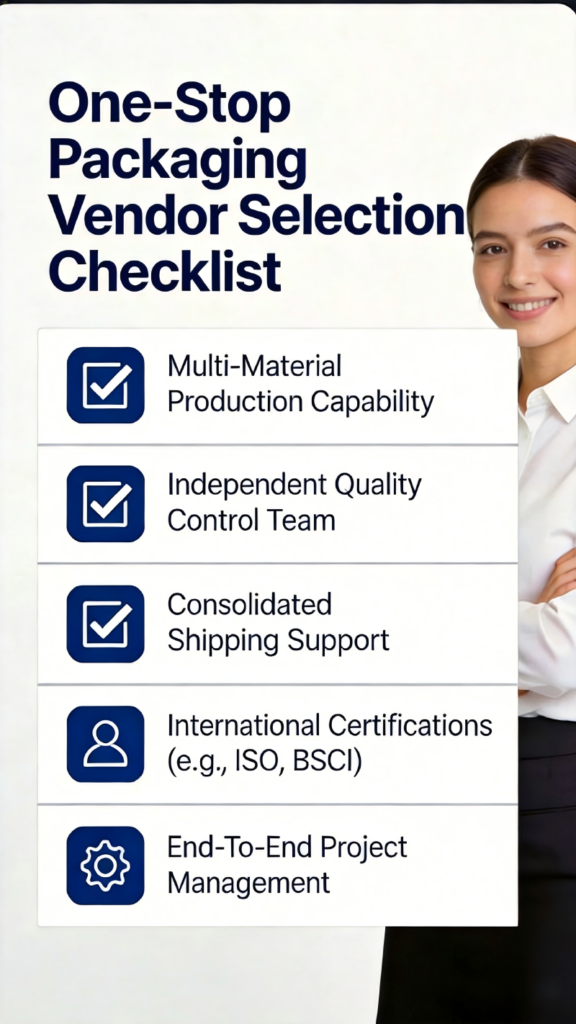
One-Stop Packaging Vendor Selection Checklist
For procurement leaders in the food, cosmetic, and daily chemical sectors, packaging sourcing is no longer a routine operational task—it is a strategic lever that directly impacts cost structure, supply chain resilience, and brand equity. Yet many purchasing teams still manage fragmented supplier networks, sourcing glass bottles from one vendor, plastic containers from another, and paper cartons from a third. This approach, while seemingly competitive on unit pricing, introduces hidden costs that procurement professionals cannot afford to overlook.
The Procurement Case for Consolidation
Fig. 1 — Traditional multi-supplier flow vs. consolidated one-stop sourcing
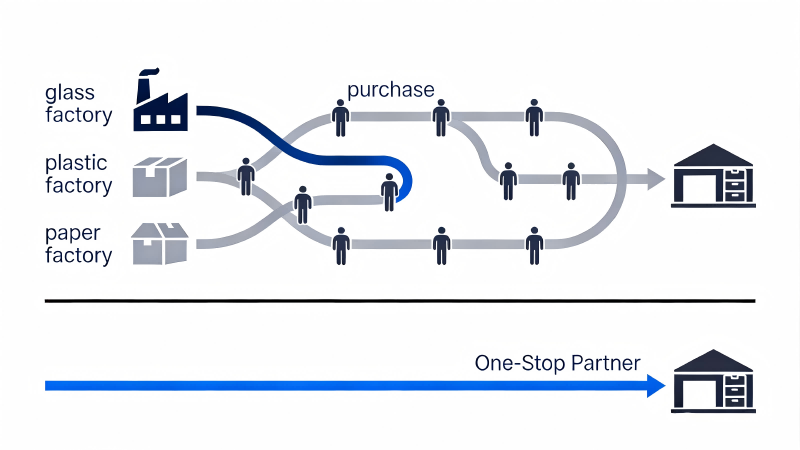
Managing multiple packaging suppliers creates a compounding administrative burden. Each vendor requires separate qualification audits, contract negotiations, purchase order processing, invoice reconciliation, and performance monitoring. When lead times differ and quality standards vary, procurement teams spend disproportionate time on firefighting rather than strategic sourcing. Furthermore, fragmented supply chains increase exposure to disruption—a delay from any single supplier can stall an entire product launch.
Beyond Unit Cost: Total Cost of Ownership
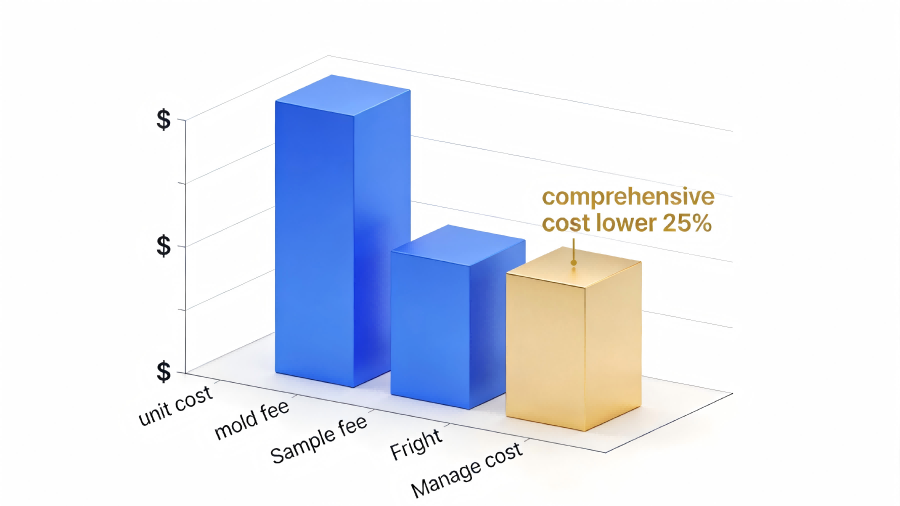
A truly optimized procurement strategy evaluates total cost of ownership (TCO), not just piece-price. When working with a single integrated packaging partner, buyers consolidate order volumes, qualifying for tiered pricing across material types—whether plastic, glass, aluminum foil, or paper. More importantly, a unified supplier eliminates redundant setup fees, reduces sample approval cycles, and minimizes the risk of costly rework caused by incompatible components. These savings, when aggregated across product lines, often yield a 15–25% reduction in total packaging procurement expenditure.
Fig. 2 — Total cost of ownership: fragmented vs. integrated procurement
Mitigating Supply Chain Risk
Supply chain volatility has elevated risk management to a board-level priority. A one-stop packaging provider offers procurement teams greater visibility and control. With all production—from structural design through decoration and assembly—managed under one roof, buyers gain single-point accountability. This simplifies quality audits, streamlines corrective action processes, and enables faster response to capacity fluctuations. For international buyers, consolidated sourcing also simplifies regulatory compliance, as a single partner assumes responsibility for material certifications and documentation across multiple jurisdictions.
Accelerating Time-to-Value
In competitive markets, speed matters. Brands that reduce packaging development cycles gain first-mover advantage. A turnkey packaging partner eliminates the back-and-forth between separate suppliers during the design and sampling phase, cutting lead times by weeks. Procurement leaders who adopt this integrated model report faster project execution, reduced internal coordination overhead, and improved agility in responding to changing market demands.
The Strategic Takeaway
For procurement decision-makers, the choice is clear: a one-stop packaging solution delivers measurable financial returns, reduces operational complexity, and strengthens supply chain resilience. It transforms packaging procurement from a transactional cost center into a strategic function that supports long-term business growth. In an increasingly uncertain global market, the simplicity and reliability of an integrated supply chain are not just conveniences—they are competitive imperatives.